HiSim ROE — a hybrid LLM + ABM population on one kernel
studies/hisim_roe/ · reference: true · Path B (from scratch on the core
kernel)
On a Twitter-like platform, after the news "the Supreme Court overturns Roe v. Wade" fires, how do the opinions of LLM-driven core users and ABM-driven ordinary users evolve — and which cohort actually moves the aggregate? This case is the pattern for a hybrid population: two cohorts sharing one environment, one panel and one metric set, but running completely different behaviour functions. It is also the pattern for porting an external simulator (HiSim) natively onto the core interfaces rather than wrapping it.
P / E / B
| what it is | where it comes from | |
|---|---|---|
| P | 20 agents: 8 core-* (LLM role-play) + 12 ord-* (bounded-confidence rule). Opinions initialized uniformly on [-1, 1], deterministic under seed: 42. Interaction is explicit_network — a 16-edge directed ring over the core users only; propagation contagion. |
population/population.json (materialized_count: 20) |
| E | Three layers, one scheduled event and one broadcast — see below. Provider hisim.twitter_env with n_core: 8, n_ord: 12, alpha: 0.3, bc_bound: 0.1, target: "the protection of Abortion Rights". |
environment/environment.json |
| B | Decision hisim.hybrid_decision (mode: llm, gpt-4o-mini). Core users role-play and act; their opinion is then mirrored off the tweet they produced. Ordinary users run the Deffuant rule. |
model.py |
| layer | modality | scope | dynamics | content |
|---|---|---|---|---|
tweet_feed |
information | local | endogenous | the audience timeline of recent tweets |
trigger_news |
information | macro | scheduled | the offline event news broadcast |
peer_opinion |
physical | macro | endogenous | global confidence-band peer opinions (BCM) |
At step 2 a scheduled event sets trigger_news.content, and broadcast N1
("News- a major event concerning the protection of Abortion Rights occurs.")
goes out to audience: "all" with ttl 4.
The two behaviour branches, precisely:
- Core (LLM) — one role-play call per core user per step, producing an
action and a stance; the agent's opinion is rewritten to
sign(stance) · |sentiment|. Observed action kinds across the run:retweet18,post10,like2,do_nothing2. - Ordinary (ABM) — the Deffuant bounded-confidence update
new = x + alpha · (peer − x)applied only when|peer − x| < bc_bound(alpha0.3,bc_bound0.1). 48update_opinionactions over the run — 12 agents × 4 decided steps.
The LLM branch is a variance source (an opinion can jump, even flip sign); the rule branch is a contraction operator (it only pulls neighbours closer). Which one wins is an empirical question, and this study answers it.
One step, and the horizon
One step is one platform turn: core users see their timeline plus any live
broadcast and act; ordinary users assimilate toward peers inside the confidence
band; metrics are then computed over all 20 agents. n_steps: 4, seed: 42,
so five metric rows (t=0 plus four decided steps).
This study runs one interaction round per step
The committed simulation/simulation.json has interaction_rounds: 1,
even though the study's demonstrates list mentions multi-round messaging.
What ships and what ran is single-round. If you want several message
exchanges inside one step, that is a config change — see
Multi-Round Interaction.
Results
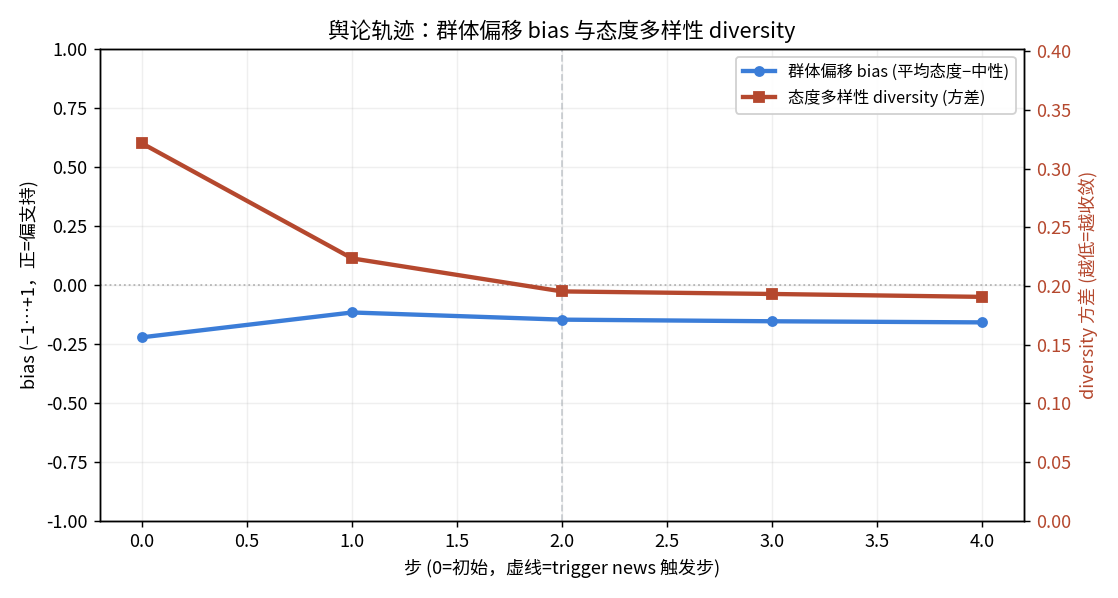
| step | bias |
diversity |
mean_core |
mean_ordinary |
n_active |
n_post |
|---|---|---|---|---|---|---|
| 0 | -0.2223 | 0.32156 | -0.1112 | -0.2964 | 0 | 0 |
| 1 | -0.1170 | 0.22357 | +0.1559 | -0.2990 | 6 | 6 |
| 2 (news) | -0.1474 | 0.19541 | +0.0885 | -0.3047 | 8 | 7 |
| 3 | -0.1543 | 0.19324 | +0.0749 | -0.3070 | 8 | 7 |
| 4 | -0.1590 | 0.19076 | +0.0653 | -0.3085 | 8 | 8 |
Net over the horizon: bias +0.0633, diversity −0.1308 (the population
converges). The two cohorts diverge sharply — core moved +0.1765 while
ordinary moved only −0.0121.
The instructive detail is when the movement happened. The largest single-step
change in bias is step 1 at +0.1053 — before the news fires. The news
step itself moves bias by only −0.0304, and core activity was already 6/8
at step 1 before saturating at 8/8. At this scale the LLM cohort's own
expression dominates the aggregate, not the exogenous shock: the target topic
is present in the core users' prompts from the start, so they express
immediately and the one-off news is marginal on top of an already-high activity
level.
The second reading is the mirror image: high activity is not large movement.
Core activity is saturated from step 2 on, but bias is nearly flat from step
2 to step 4 — because eight core opinions of mixed sign partly cancel, and the
12 ordinary users (60% of the panel, ending at −0.3085) barely move and anchor
the aggregate near their starting level.
Grounding
Four sourced facts, three declared assumptions, two implementation references.
| entry | basis | role |
|---|---|---|
| Dobbs v. Jackson overturned Roe on 2022-06-24 (SCOTUSblog) | sourced |
the real exogenous shock trigger_news stands for |
| Pew: ~61% said abortion should be legal in all/most cases (pre-decision) | sourced |
the real prior the uniform initialization deliberately does not use |
| Pew post-decision: 57% disapprove / 41% approve, n = 6,174 | sourced |
the net-negative attitude the demo's bias must not be read as predicting |
HiSim's own published ROE config: 1000 ordinary agents, alpha 0.3, 14 turns |
sourced |
the reference scale this showcase is a reduction of |
| 8 core + 12 ordinary over 4 steps instead of 1000 over 14 | assumed |
exercises the full real-LLM path at demo cost; counts are declared adjustable_params |
| uniform [-1, 1] initial opinions rather than a Pew-skewed prior | assumed |
HiSim's real ROE user data is not bundled here, so the real-data path cannot run |
| TextBlob polarity as the sentiment function in the att mirror | assumed |
a light stand-in faithful to the sign-times-magnitude mirror shape |
Implementation references: Mou et al. (2024), Unveiling the Truth and Facilitating Change (HiSim, ACL 2024 Findings) — the paper this study ports; and Deffuant, Neau, Amblard & Weisbuch (2000), Mixing beliefs among interacting agents — the bounded-confidence rule behind the ordinary cohort.
Because the initial opinions are uniform rather than Pew-calibrated, the
absolute level of bias carries no polling claim. What transfers is the
relative mechanism: cohort divergence, convergence in diversity, and the
timing of the shock.
What you can fork
| param | the question it opens |
|---|---|
n_core / n_ord |
at 8 vs 12 the LLM cohort dominates. Push the ratio toward HiSim's 1000 ordinary users and the silent majority should reassert itself — at what mix does the crossover happen? |
alpha |
how fast the silent majority assimilates; the anchor's stiffness. |
bc_bound |
0.1 is narrow. Sweep to ~0.5 for the classic bounded-confidence transition from fragmentation to consensus — and check whether the LLM cohort shifts the critical point. |
| news schedule | fire the news at step 1, or fire a second wave, and test whether bias shows a genuine second inflection once the topic is not already saturated. |
target |
the same hybrid machinery on a different issue. |
The report's own first recommendation is a parity fork: run the same study with a deterministic scripted decision instead of the LLM, and measure whether role-play introduces a systematic shift versus the rule stub. Structure and mechanics of building this way are in Build a Study from Scratch (Path B).